
Welcome to the Sorting Hat for HomeownersIf Hogwarts had a campus in State College (and honestly, it should—those turrets would look spectacular against a football Saturday sky), the Sorting

Dated: June 23 2023
Views: 267
The recently released "CENTRE COUNTY, PA | 2023 HOUSING NEEDS ASSESSMENT" by the Centre County Board of County Commissioners, Centre County Planning & Community Development Office, and Centre Region Planning Agency, offers a comprehensive analysis of the housing landscape in Centre County, Pennsylvania. Funded by the Community Development Block Grant (CDBG) and the American Rescue Plan Act (ARPA), the report provides a detailed account of the housing market, influenced significantly by the presence of Penn State University's main campus.
However, many stakeholders, including myself, were expecting the report to include recommendations for addressing the housing challenges identified. While the assessment provides a thorough outline of the housing landscape, it stops short of suggesting actionable strategies for creating and preserving affordable housing in the region. I will share thoughts about that following a recap of the main takeaways from the report.
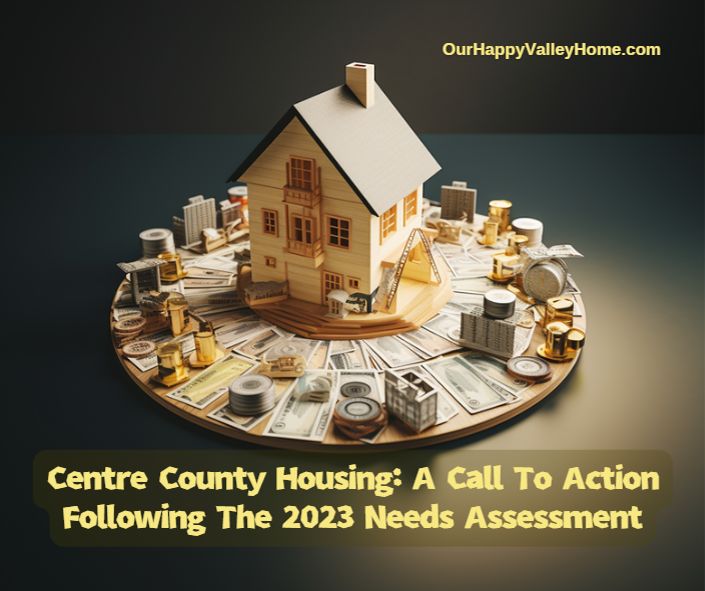
Illustration Credit: Midjourney
1. Penn State University's Influence on the Housing Market: The main campus of Penn State University, located in the greater State College area, is a significant economic engine driving the housing market in Centre County. With an on-campus enrollment of 40,000 students and a staff of 22,000, the university has a substantial impact on many aspects of life in the borough and beyond. Many out-of-state students come to Penn State, graduate, and decide to establish roots in or near State College. This influx of graduates seeking to settle in the area creates a high demand for affordable housing. One of their most significant post-graduation challenges is finding a place to live affordably. The university's presence also contributes to State College's desirability, with the area ranking in the top twenty of Kiplinger’s Personal Finance magazine’s “Fifty Smart Places to Live”.
2. Student Rental Housing and High-End Housing: The market for off-campus student rental housing is lucrative, but the rental rates are often unaffordable for most non-student households. This situation creates a dichotomy in the housing market. On one end, there's a thriving rental market catering to students, with rates that are often out of reach for non-student households. On the other end of the market, there are popular single-family detached units on large lots that sell for upwards of $300,000 in the surrounding townships. These units are permitted by right in zoning ordinances with few innovative provisions amidst fear of encroachment of student housing into neighboring municipalities.
3. Housing Development Challenges and Opportunities: Beyond the Centre Region, new housing development remains a challenge. A general lack of infrastructure restricts density to single-family detached units on larger lots, making multi-family housing more costly to develop if not outright impossible. However, in and around the older boroughs across the county are smaller population centers where housing is generally more affordable. The challenge in these areas is to maintain the quality of the older inventory through regular maintenance, to lower cost burden through energy-efficiency improvements, and focus on infill development and adaptive re-use of non-residential structures. These efforts could help to increase the availability of affordable housing options.
4. Public Opposition to Higher Density Development: The document discusses the challenge of changing zoning that has been in place for a long time due to the uncertainty over how the changes will impact long-time residents, especially single-family homeowners. According to stakeholders, many existing zoning ordinances are dated and proposed revisions often encounter public opposition from residents who would prefer to maintain the status quo. This opposition can be a significant barrier to the development of higher density housing, which could potentially provide more affordable housing options.
5. Opportunity Index: The document includes an Opportunity Index, which identifies areas where new affordable housing developments may be more financially feasible in the long term due to proximity to factors that allow residents to have successful access to employment, quality education, and a healthy environment. The index is a tool that can help communities analyze opportunity, comprehensively and comparatively, to communicate who has access to opportunity-rich areas and who does not, and to understand what needs to be remedied in opportunity-poor communities.
6. Housing Gap Analysis: The document also includes a Housing Gap Analysis, which indicates the number of additional housing units by tenure and affordability needed for the housing inventory to match the number of households within the corresponding affordability/income tier. The gap represents the mismatch in households and units based on both the number of units in the AMI tier and/or households outside the AMI tier residing in the units. The housing gap within each income tier does not represent the number of units that need to be built. Rather, it reveals the need for available and affordable units across all income tiers.
7. Stakeholder Engagement: The study heavily relied on stakeholder engagement, with more than 150 stakeholders identified by the Centre County Planning and Development Office. These stakeholders were invited to participate in 11 virtual sessions conducted in March and April 2022. More than 175 individuals participated and provided insightful commentary on their own experiences as well as the experiences of their clients they represent. From these sessions emerged a nuanced profile of the housing market as told by stakeholders of residents trying to find or keep housing, advocates challenged by rising rents and few available units to find landlords to house their clients, home builders who have encountered public opposition when seeking development approvals to expand housing inventory to meet demand, nonprofit organizations on shoe-string budgets trying to acquire parcels of land and units to preserve their affordability, and many more scenarios that carefully detailed the struggle of working within a challenging environment to house Centre County residents affordably. This engagement formed the basis for much of the research conducted for the study, providing a rich and detailed understanding of the housing market in Centre County.
In light of the fact that the report contained no recommendations, I would like to propose several strategies that could be derived from the report's findings:
Promoting Higher Density Development: The report highlights the need for more affordable housing. One way to address this is by promoting higher density development, such as multi-family units. This would involve revising zoning ordinances and educating the public about the benefits of such development.
Incentivizing Affordable Housing Development: The assessment suggests a need for more affordable housing options. To encourage developers to build affordable housing, the county could offer incentives such as tax breaks, streamlined permitting processes, or direct subsidies.
Preserving Existing Affordable Housing: The report underscores the importance of preserving the existing stock of affordable housing. Strategies for preservation could include providing financial assistance or incentives to property owners to maintain the affordability of their units.
Investing in Infrastructure: The assessment points to the need for infrastructure investment outside the Centre Region to facilitate housing development. This would make multi-family housing development more feasible in these areas, providing more housing options for residents.
Promoting Infill Development and Adaptive Reuse: The report suggests that infill development and the adaptive reuse of non-residential structures can increase the supply of affordable housing without requiring the development of new land.
Implementing an Affordable Housing Trust Fund: The establishment of a local affordable housing trust fund could provide a continuous source of funding for affordable housing initiatives.
Engaging Stakeholders: The report emphasizes the importance of stakeholder engagement in the planning and decision-making process. Regular meetings with community members, housing advocates, developers, and other stakeholders can ensure that the county's housing policies and strategies effectively address the community's needs.
Promoting Public-Private Partnerships: The assessment suggests that public-private partnerships can leverage the resources and expertise of each sector to create more effective housing solutions.
Regularly Reviewing and Updating Housing Policies: The report underscores the importance of regularly reviewing and updating housing policies to ensure they effectively address the current housing needs of the community.
Promoting Homeownership Programs: Finally, the report suggests that promoting programs that assist low- and moderate-income households in becoming homeowners can provide a long-term solution to housing affordability.
While the "CENTRE COUNTY, PA | 2023 HOUSING NEEDS ASSESSMENT" does not include recommendations, it provides a solid foundation upon which we can build strategies to address the housing challenges in Centre County. By implementing these strategies, we can create a more inclusive and affordable housing market that meets the needs of all our residents.
Frances Thorsen is a leading real estate author and thought leader. She got her real estate license and became a REALTOR® in 1985. She was an early adopter of real estate technology on the Interne....
Welcome to the Sorting Hat for HomeownersIf Hogwarts had a campus in State College (and honestly, it should—those turrets would look spectacular against a football Saturday sky), the Sorting
In a move that could significantly alter the landscape of real estate transactions in the United States, the Department of Justice (DOJ) has recently filed a statement of interest in a major ongoing
Pippi Longstocking: "Good day! It's me, Pippi Longstocking, ready to embark on the grand adventure of selling my beloved Villa Villekulla. But, oh my stars, I hear things are changing in the
Get ready for some fun insights from Zillow's cool research in 2023. You won't believe what people have been typing into Zillow's search bar! 🏠✨Picture this: millions of Americans, just like
 The data relating to real estate for sale on this web site comes in part from the Internet Data Exchange of the Greater Lehigh Valley REALTORS®. Real Estate listings held by brokerage firms (licensees) other than #firm are marked with the IDX logo and detailed information about them includes the name of the listing brokers.
The information being provided is for consumers personal, non-commercial use and may not be used for any purpose other than to identify prospective properties consumers
may be interested in purchasing.
Data last updated September 23, 2026 3:32 PM UTC
Show More...
The data relating to real estate for sale on this web site comes in part from the Internet Data Exchange of the Greater Lehigh Valley REALTORS®. Real Estate listings held by brokerage firms (licensees) other than #firm are marked with the IDX logo and detailed information about them includes the name of the listing brokers.
The information being provided is for consumers personal, non-commercial use and may not be used for any purpose other than to identify prospective properties consumers
may be interested in purchasing.
Data last updated September 23, 2026 3:32 PM UTC
Show More...
 © BRIGHT, All Rights Reserved
Information Deemed Reliable But Not Guaranteed
The data relating to real estate for sale on this website appears in part through the BRIGHT Internet Data Exchange program, a voluntary cooperative exchange of
property listing data between licensed real estate brokerage firms in which
participates, and is provided by BRIGHT through a licensing agreement.
The information provided by this website is for the personal,
non-commercial use of consumers and may not be used for any purpose other than to identify prospective properties consumers may be interested in purchasing.
Data last updated: September 23, 2026 1:48 PM UTC
Some properties which appear for sale on this website may no longer be available
because they are under contract, have Closed or are no longer being offered for sale.
Some real estate firms do not participate in IDX and their listings do not appear on this website. Some properties listed with participating firms do not appear on this website at the request of the seller.
Show More...
 All information deemed reliable but not guaranteed. All properties are subject to prior sale, change or withdrawal. Neither listing broker(s) or information provider(s) shall be responsible for any typographical errors, misinformation, misprints and shall be held totally harmless. Listing(s) information is provided for consumer's personal, non-commercial use and may not be used for any purpose other than to identify prospective properties consumers may be interested in purchasing. The data relating
to real estate for sale on this website comes in part from the Internet Data Exchange program of the Multiple Listing Service. Real estate listings held by brokerage firms other than eXp Realty in Centre County may be marked with the Internet Data Exchange logo and detailed information about those properties will include the name of the listing broker(s) when required by the MLS. Copyright ©2026 All rights reserved.
Last Updated: September 23, 2026 3:24 PM UTC
Show More...
All information deemed reliable but not guaranteed. All properties are subject to prior sale, change or withdrawal. Neither listing broker(s) or information provider(s) shall be responsible for any typographical errors, misinformation, misprints and shall be held totally harmless. Listing(s) information is provided for consumer's personal, non-commercial use and may not be used for any purpose other than to identify prospective properties consumers may be interested in purchasing. The data relating
to real estate for sale on this website comes in part from the Internet Data Exchange program of the Multiple Listing Service. Real estate listings held by brokerage firms other than eXp Realty in Centre County may be marked with the Internet Data Exchange logo and detailed information about those properties will include the name of the listing broker(s) when required by the MLS. Copyright ©2026 All rights reserved.
Last Updated: September 23, 2026 3:24 PM UTC
Show More...
